
Last updated: 08 October 2026 · Reviewed by We Design For You – DGFT and Government Scheme Advisory Team
Disclaimer: This is an informational article prepared by We Design For You, a private consultancy. It is not an official APEDA notification. Always verify details with the official guidelines on apeda.gov.in.
Introduction
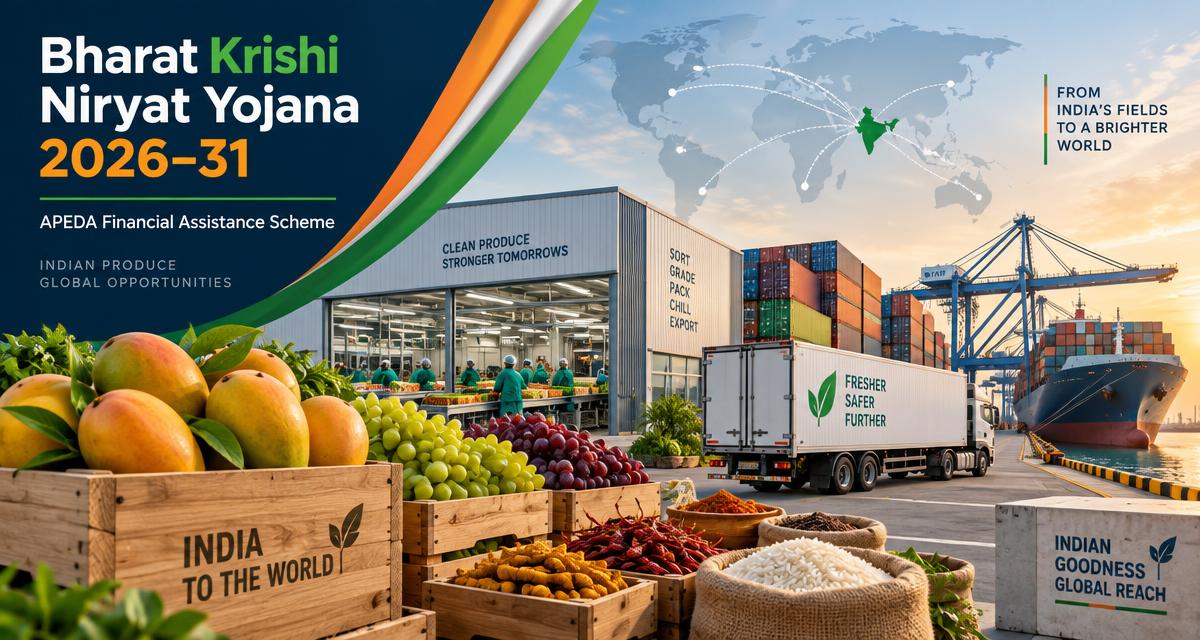
The Agricultural and Processed Food Products Export Development Authority (APEDA) has issued a circular dated 06 October 2026 announcing guidelines for the Bharat Krishi Niryat Yojana 2026–31 for the Finance Commission cycle FY 2026–27 to FY 2030–31.
The scheme was formerly known as the Agriculture and Processed Foods Export Promotion Scheme of APEDA, popularly called the APEDA Financial Assistance Scheme (FAS). It has been approved by the Department of Commerce with an enhanced total budget outlay of ₹540 crore for five years. Its objective is to strengthen India’s agricultural and processed-food export ecosystem.
What is Bharat Krishi Niryat Yojana?
APEDA was set up under the Agricultural and Processed Food Products Export Development Authority Act, 1985 to develop and promote exports of its Scheduled products. The Bharat Krishi Niryat Yojana is APEDA’s financial assistance scheme for stakeholders dealing in APEDA-scheduled products — fresh agricultural products, animal-based products and processed food products — and NPOP-certified organic products.
The scheme is designed to improve export infrastructure, quality compliance and international market access.
Main components of the scheme
A. Development of Export Infrastructure
- Integrated pack houses and processing facilities
- Cold storage and pre-cooling units
- Reefer and insulated transport, mobile pre-cooling units
- Pre-shipment treatment facilities
- Common infrastructure by government institutions
- Equipment for food safety and quality improvement
B. Quality Development
- Food safety and quality management systems (HACCP, ISO 22000-related compliance)
- Testing laboratories and laboratory equipment
- Traceability systems
- Reimbursement of eligible testing charges
- Sustainability and ethical-trade certifications
- Product and technology development, quality packaging systems
C. Market Development
- International trade fairs, buyer–seller meets and reverse buyer–seller meets
- Trade delegations and trial shipments
- Market intelligence and feasibility studies
- Export packaging development
- GI product branding and promotion
- International retail-chain listing support
Who can benefit?
| Beneficiary category | Examples of support | Important note |
|---|---|---|
| APEDA-registered exporters | Pack houses, processing, cold chain, market development | Valid APEDA RCMC required |
| Manufacturer-exporters | Processing lines, quality equipment, certifications | Component conditions apply |
| Merchant exporters | Market development, testing, packaging | Eligibility varies by sub-component |
| Farmer Producer Organisations (FPOs) | Infrastructure at enhanced assistance | Up to 75%, subject to ceilings |
| PACS | Infrastructure at enhanced assistance | Up to 75%, subject to ceilings |
| SC/ST beneficiaries | Infrastructure at enhanced assistance | Evidence of category required |
| Women beneficiaries | Infrastructure at enhanced assistance | Evidence of category required |
| Startups | Infrastructure at enhanced assistance | Evidence of category required |
| State and Central Government institutions | Common infrastructure | Restricted to specified regions |
| Public-sector enterprises | Common infrastructure | Restricted to specified regions |
| Food-testing laboratories | Laboratory equipment, accreditation | NABL conditions where applicable |
| NPOP-certified organic operators | Support for organic products | NPOP certification required |
Eligibility varies by sub-component. Some components are restricted to specific government institutions, regions or beneficiary categories.
Financial assistance pattern
Summary (subject to applicable guidelines and approval)
- Up to 75% for eligible special categories and specified regions, subject to component-wise ceilings.
- Up to 40% for other eligible applicants or projects, subject to applicable limits.
- Up to 90% for certain government common-infrastructure projects, where specifically permitted.
- All assistance is subject to APEDA approval, eligible cost, available funds and scheme conditions.
| Sub-component | General assistance | Maximum ceiling | Key note |
|---|---|---|---|
| Integrated pack house and processing facilities (missing gaps) | Up to 75% (specified categories/regions); up to 40% (others) | ₹250 lakh | New projects only |
| Upgradation or expansion of eligible facilities | Up to 75%; up to 40% (others) | ₹200 lakh | Existing facilities |
| Reefer vehicles, insulated transport, mobile pre-cooling units | Up to 75%; up to 40% (others) | ₹200 lakh | Includes livestock carriers |
| Food-processing facilities for missing gaps | Up to 75%; up to 40% (others) | ₹200 lakh | Processing equipment |
| Common infrastructure by government institutions | Up to 90% | ₹600 lakh | NER, Ladakh, J&K, A&N, Lakshadweep only |
| Upgradation of such common infrastructure | Up to 90% | ₹200 lakh | Same regions only |
Per the guidelines, total assistance to a beneficiary across the exporter infrastructure sub-components should not exceed ₹300 lakh per plan period.
Percentages and ceilings are subject to the exact sub-component, eligible cost, applicant category, geographical location, APEDA approval and availability of funds. Applicants should verify the latest official guidelines before making financial commitments.
Special categories and regions
Enhanced assistance may apply to the North-Eastern Region, Ladakh, Jammu and Kashmir, Andaman and Nicobar Islands and Lakshadweep, and to FPOs, PACS, SC/ST beneficiaries, women beneficiaries and startups. Applicants must provide evidence and undertakings proving continued eligibility wherever required.
Important eligibility conditions
- Valid APEDA RCMC wherever applicable.
- The project must relate to APEDA-scheduled products or NPOP-certified organic products.
- Online application through the APEDA portal is mandatory.
- Expenditure incurred before the online application may not qualify.
- New and upgradation projects must satisfy the relevant sub-component conditions.
- Land ownership or a registered long-term lease may be required for infrastructure projects.
- A registered lease must generally have the remaining validity stated in the guidelines (for example, 15 years at the time of application for integrated pack houses).
- Required statutory permissions, licences and approvals must be obtained.
- Food-processing applicants may need an established processing line and a recognised food-safety management system.
- Assistance received or applied for from other government agencies must be disclosed.
- Duplicate assistance for the same component is not permitted.
- Information and documents must be accurate and complete.
- APEDA may conduct technical scrutiny, financial evaluation, pre-inspection and physical verification.
- The final decision rests with APEDA; submitting an application does not create an entitlement to assistance.
Documents generally required
- ✅ APEDA RCMC
- ✅ Certificate of incorporation or registration
- ✅ PAN and GST documents
- ✅ IEC, wherever applicable
- ✅ MoA/AoA or partnership documents
- ✅ Udyam registration, if applicable
- ✅ Detailed Project Report (DPR) and project cost estimates
- ✅ Equipment quotations (minimum three where required)
- ✅ Chartered Engineer certificate
- ✅ Land ownership or registered lease documents; CLU where applicable
- ✅ Building layout and technical drawings
- ✅ Bank sanction letter or appraisal note, wherever applicable
- ✅ Audited financial statements and annual reports
- ✅ Statutory permissions, FSSAI and other registrations
- ✅ Food-safety certification; NPOP documents for organic products
- ✅ Declarations regarding other government assistance
- ✅ Bank details and any additional documents requested by APEDA
The exact document list depends on the selected component.
Application and approval process
- Identify the relevant scheme component.
- Confirm APEDA registration and product eligibility.
- Prepare the project report, quotations and supporting documents.
- Submit the online application through the APEDA portal.
- Pay the applicable non-refundable fee, if prescribed.
- Receive the application tracking number.
- Technical and financial scrutiny by APEDA.
- Evaluation by the Technical Committee, wherever applicable.
- Issue of In-Principle Approval.
- Project implementation and submission of claim documents.
- Document verification and physical inspection.
- Release of eligible assistance to the applicant’s bank account.
APEDA may invite applications based on priority products, geographical areas, beneficiary categories, first-time applicants and availability of funds. As per the circular, APEDA will invite applications shortly along with the selection criteria.
Release of grant
Wherever applicable, the grant is released in three instalments:
- First instalment – 40%: after fulfilment of applicable conditions and submission of the required bank guarantee.
- Second instalment – 40%: after proof of expenditure, applicant contribution, certificates and inspection.
- Final instalment – 20%: after commissioning and submission of final documents.
The release pattern may vary according to the sub-component and approval conditions. The guidelines also provide for an APEDA processing fee on the eligible amount, deducted at the time of release.
Compliance after approval
- Maintain a separate bank account where required.
- Use the grant only for the approved purpose.
- Submit quarterly or periodic performance reports.
- Preserve assisted assets for the required period.
- Display the required APEDA acknowledgement on assisted capital assets.
- Maintain bills, bank statements and payment records.
- File final claim documents before the validity period expires.
- Obtain required certifications such as NABL accreditation for laboratories, where applicable.
- Refund assistance with interest or penalties in cases of misuse, non-implementation, concealment or violation of conditions.
Common mistakes to avoid
⚠️ Avoid these errors
- Starting expenditure before the online application
- Submitting an incomplete DPR
- Using quotations that do not meet the required format, or too few quotations
- Applying under the wrong sub-component
- Ignoring land or statutory approval requirements
- Claiming duplicate government assistance
- Failing to maintain bank and expenditure records
- Missing the final claim deadline
- Treating the scheme as an automatic subsidy rather than an approved financial-assistance programme
How We Design For You can help
Our Hyderabad-based team supports exporters, food processors and FPOs across India with:
- Scheme and component identification, and preliminary eligibility review
- APEDA RCMC and export documentation review
- DPR coordination and application preparation
- Document checklist, compliance review and quotation coordination
- Liaison, follow-up and deficiency responses
- Claim documentation, inspection coordination, disbursement and post-approval compliance
We help businesses prepare and manage their applications, but approval depends on APEDA’s assessment, applicable guidelines, budget availability and the applicant’s compliance.
Get an APEDA Scheme Eligibility Review
Phone: +91 8179329698 · Location: Hyderabad, Telangana · Service area: Pan-India
Related services: DGFT Consulting · Industrial Subsidy Consulting · IEC Registration · RCMC Services · Export Incentives (RoDTEP) · Government Scheme Advisory
Frequently asked questions
What is the Bharat Krishi Niryat Yojana?
It is APEDA’s Financial Assistance Scheme, formerly the Agriculture and Processed Foods Export Promotion Scheme, supporting export infrastructure, quality development and market development for APEDA-scheduled and NPOP-certified organic products.
What is the budget of the APEDA BKNY scheme?
An enhanced total outlay of ₹540 crore for five years.
What is the duration of the scheme?
FY 2026–27 to FY 2030–31.
Who can apply under the scheme?
APEDA-registered exporters and, for specific components, government institutions, public-sector enterprises, laboratories and other categories. Eligibility varies by sub-component.
Can FPOs and startups receive assistance?
Yes. FPOs, PACS, SC/ST, women beneficiaries and startups holding APEDA RCMC may get up to 75% for certain infrastructure sub-components, subject to ceilings and approval.
What infrastructure is supported?
Integrated pack houses, processing facilities, cold storage, pre-cooling, reefer and insulated transport, pre-shipment treatment and common infrastructure.
Does APEDA support cold-chain projects?
Yes — cold storage, pre-cooling, reefer vehicles and mobile pre-cooling units are covered, subject to guidelines and approval.
What assistance is available for food-processing equipment?
Processing facilities for missing gaps may receive up to 75% (specified categories/regions) or up to 40% (others), with a ceiling of ₹200 lakh, subject to approval.
Is APEDA RCMC mandatory?
A valid APEDA RCMC is required wherever applicable, including for exporter infrastructure sub-components.
Can a project receive assistance from two government schemes?
Duplicate assistance for the same component is not permitted, and other assistance must be disclosed.
Is expenditure incurred before application eligible?
Expenditure incurred before the online application may not qualify.
How is the financial assistance released?
Usually in instalments of 40%, 40% and 20%, linked to conditions, expenditure proof, inspection and commissioning.
Does APEDA guarantee approval?
No. Approval depends on APEDA’s assessment, scheme conditions and available funds.
How can We Design For You help with the application?
We help with eligibility review, DPR and document preparation, filing, follow-up, inspection coordination and claim documentation. Email bd@wedesignforyou.in or call +91 8179329698.
Conclusion
The Bharat Krishi Niryat Yojana 2026–31 offers a structured opportunity to strengthen agricultural export infrastructure, improve quality compliance and expand market access. Review your eligibility and prepare your documents before APEDA’s official application window opens.
Source: APEDA Circular F.No. APEDA-BFD/18/2025-BFD dated 06.10.2026 and APEDA FAS Guidelines. Official website: apeda.gov.in.
Tags: APEDA, Bharat Krishi Niryat Yojana, Agriculture Exports, Food Processing, Export Subsidy, FPO, Cold Chain, DGFT Consultancy